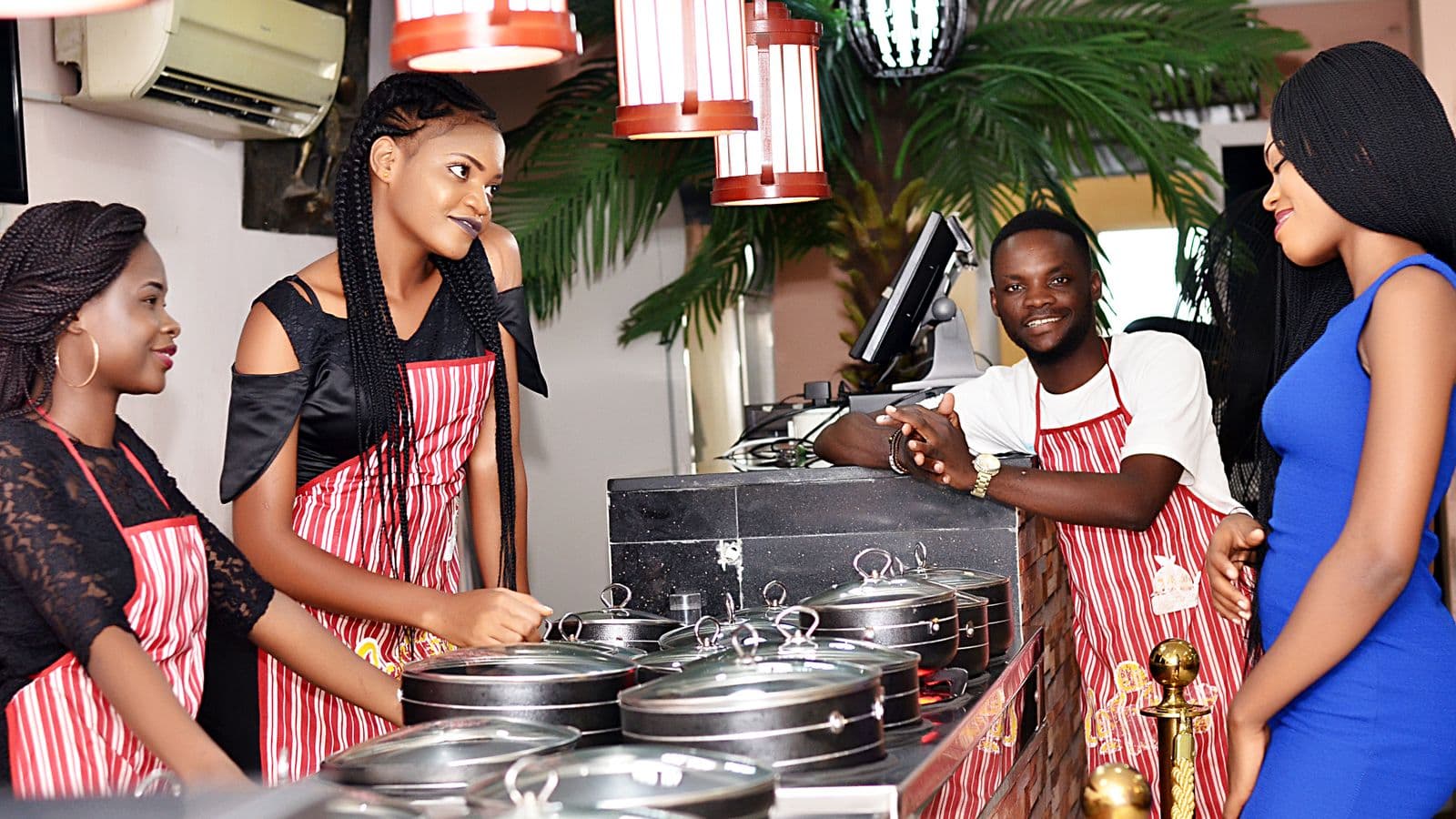
A restaurant in Cameroon is a constant flow: table orders, kitchen, deliveries, market purchases, employees to pay, VAT to declare. And all of this often relies on an order notebook, a basic till, and the manager's memory. The result: invisible inventory losses, unknown margins, and approximate accounting.
This guide explains the specific needs of a Cameroonian restaurant in terms of management, and what an adapted ERP can change for your profitability day-to-day.
The specific challenges of a restaurant
1. Raw material management
A restaurant does not buy finished products — it buys raw materials (vegetables, meats, fish, spices, oil, gas) that it transforms. Inventory tracking is therefore more complex than in a retail shop:
- Prices fluctuate. The price of fish at Douala market changes every week.
- Units vary. You buy in kg, in bags, in trays, and you use in portions.
- Waste is unavoidable. Peels, bones, cooking: input weight does not match output weight.
- Theft is common. The kitchen is an environment where tracing every ingredient is difficult.
Without a system, you do not know what each dish actually costs you. And if you do not know your cost, you do not know your margin.
2. The point of sale and orders
Restaurant order flow is irregular and fast. The POS must be able to:
- Record orders by table or number.
- Handle different product categories (starters, mains, desserts, drinks).
- Separate dine-in, takeaway and delivery orders.
- Handle split bills (one client pays for themselves, another pays for the group).
- Accept multiple payment methods: cash, MTN MoMo, Orange Money, bank card.
- Print or send the bill/receipt.
3. Suppliers and purchases
A restaurant buys from many suppliers: market vendors, wholesalers, butchers, fishmongers, beverage suppliers, etc. Many of these purchases are made in cash, without a formal invoice. Tracking is therefore approximate:
- How much did you spend on fish this month?
- Which supplier gives you the best value for money?
- Have you paid all your bills?
4. Staff payroll
A restaurant often employs temporary and permanent staff: cooks, waiters, dishwashers, manager. Payroll must comply with Cameroonian law (CNPS, IRPP), even for daily workers. Tracking overtime, leave and absences adds complexity.
5. Accounting and tax obligations
A restaurant is a business like any other: SYSCOHADA (Système Comptable de l'OHADA, the harmonized accounting framework) accounting, VAT (if applicable), CNPS (Caisse Nationale de Prévoyance Sociale, the National Social Insurance Fund)/IRPP (Impôt sur le Revenu des Personnes Physiques, Personal Income Tax) payroll, annual DSF (Déclaration Statistique et Fiscale, the annual Statistical and Tax Declaration). But the combination of many small cash purchases and frequent sales makes bookkeeping particularly tedious without proper tools.
What an adapted ERP delivers
| Need | Without ERP | With ERP |
|---|---|---|
| POS | Order notebook + basic cash register | Fast order taking, ticket printing, table management |
| Raw materials | Purchasing with no real tracking | Entry tracking, cost calculation per dish |
| Waste | Unmeasured | Waste recorded, variance analysis |
| Suppliers | Memory + notebook | Order, invoice and payment tracking |
| Mobile Money | Received on phone, not recorded | Recorded as first-class payment |
| Payroll | Manual calculation | Automated CNPS/IRPP payroll |
| VAT | Approximate calculation | Automatic on every sale |
| Margin per dish | Unknown | Calculated from actual cost |
Calculating the cost of a dish
This is the most critical question for restaurant profitability. Example: Ndole.
| Ingredient | Quantity | Unit price | Cost |
|---|---|---|---|
| Ndole leaves | 500g | XAF 1,500/kg | 750 |
| Beef | 300g | XAF 4,000/kg | 1,200 |
| Shrimp | 100g | XAF 6,000/kg | 600 |
| Groundnuts | 200g | XAF 2,000/kg | 400 |
| Oil | 10cl | XAF 1,000/L | 100 |
| Onions, spices | — | — | 150 |
| Gas (pro-rata) | — | — | 100 |
| Total cost | 3,300 |
If you sell Ndole at XAF 5,000, your gross margin is XAF 1,700 (34%). But if the price of beef rises to XAF 5,000/kg, your margin drops to XAF 1,400 (28%). An ERP that tracks purchase prices in real time alerts you when a dish becomes unprofitable.
The journey of an order in the ERP
- Order. The waiter records table 7's order: 1 Ndole, 1 Bissap juice, 1 Water. The system decrements raw material stock (or does so at service close).
- Payment. The customer pays by MTN MoMo. The POS records the payment and generates the accounting entry.
- Service close. The system calculates the service's turnover, number of covers, average basket.
- Analysis. The manager checks the dashboard: which dishes sold best? What is the margin per dish? Which ingredients need restocking?
- Month-end. VAT is calculated automatically. Payroll is generated. Financial statements are produced.
Waste and losses
Restaurant losses come from several sources:
- Peels and bones: natural preparation losses (unavoidable but measurable).
- Cooking: meat loses 30-40% of its weight during cooking.
- Waste: prepared dishes that are not sold.
- Theft: diverted ingredients.
- Errors: botched orders, returned dishes.
An ERP that records stock entries, recipe outputs and declared losses allows you to calculate the theoretical/actual variance. That is often where the real margin loss hides.
Suppliers and purchases
Many Cameroonian restaurant owners buy at the market in cash, without an invoice. That is reality. But it does not mean these purchases should not be tracked:
- Keep receipts or note each purchase in a dedicated notebook.
- Record purchases in your system, even without a formal invoice.
- Track your suppliers: who gives you the best value for money?
- Manage supplier deadlines for credit purchases.
An ERP simplifies this tracking by centralizing all purchases in one system, with accounting entries generated automatically.
Why NexaCore BOS for your restaurant
NexaCore covers the general needs of a Cameroonian restaurant with specific features:
- Fast point of sale, adapted to restaurant flow, with table management and first-class Mobile Money payment.
- Inventory management with entry tracking, cost calculation and reorder alerts.
- Integrated SYSCOHADA accounting: every sale and purchase automatically generates its entries.
- Supplier management with order and payment tracking.
- CNPS/IRPP payroll for permanent and temporary staff.
- Dashboard with a view of turnover, margins, waste and cash flow.
- Built-in AI that flags unprofitable dishes and ingredients needing restocking.
The trial is free, nothing to install. Discover NexaCore BOS.
FAQ
How do I calculate the cost of a dish?
List each ingredient with its quantity and purchase price, add a pro-rata for oil and gas. The total gives the raw material cost. Add an estimate of waste (peels, cooking) to get the true cost.
What software for a restaurant in Cameroon?
An ERP with integrated POS, ingredient-level inventory, SYSCOHADA accounting and Mobile Money management is the most efficient solution. NexaCore BOS combines these features in one platform.
How do I manage market purchases without invoices?
Note each purchase (date, supplier, amount, products) in a notebook or directly in your system. The important thing is to track expenses to know your true costs and produce faithful accounting.
Are kitchen losses tax-deductible?
Normal preparation losses (peels, cooking) are built into the cost of goods. Abnormal losses (theft, excessive waste) must be justified. Rigorous tracking of theoretical/actual variances facilitates justification.
How do I manage temporary restaurant staff?
Daily workers must be declared to the CNPS and IRPP must be withheld. Payroll software that handles part-time and daily workers simplifies this obligation. NexaCore integrates this management natively.
Go from theory to practice
NexaCore BOS does all of this for you: OHADA accounting, FCFA invoicing, payroll and more. Free trial.
Start for free